Humans had no direct way to express intent to machines. Code was the approximation — the best available path at the time. Every platform, every AI system, every enterprise tool exists because that gap was never closed. It was patched, scaled, and inherited. Essence® closes it.
The Flaws Were Never Fixed.
They Were Inherited.
Software didn't fail because engineers weren't skilled enough. It failed because the architecture was always a workaround — and every generation since has built on top of that original compromise. Here is an honest account of what that means.
Flaw 01
Performance: The Abstraction Tax Nobody Talks About
Every layer in the software stack — hardware to OS to runtime to framework to application — was designed to make programming easier for humans. That's the point. But every layer also extracts a performance cost. The machine does work the programmer never asked for, executing instructions that exist only to manage the abstractions below.
A modern web request that takes 200ms to serve might spend fewer than 5ms doing actual computation. The rest is abstraction overhead — serialization, garbage collection, context switching, memory allocation, network buffering, interpreter passes. None of it is the work. All of it is the scaffolding around the work.
"The machine is incredibly fast. The software is not."
This isn't a tuning problem. It isn't a profiling problem. It is structural. Every optimization a team achieves fights against a stack that was designed, at every layer, to trade performance for manageability. The ceiling is not the hardware. The ceiling is the abstraction stack.
Evidence
NVIDIA T4 GPU theoretical throughput: ~65 TFLOPS (FP16)
Typical deep learning training utilization: 30–45%
Why: CUDA, cuDNN, PyTorch, Python — four abstraction layers between intent and silicon.
Compiler overhead alone in a standard C++ build pipeline can account for 15–40% of runtime inefficiency through missed optimization opportunities at abstraction boundaries.
The irony is that the industry responds to this by buying more hardware. More GPUs. Larger clusters. More power. The performance gap is treated as a procurement problem when it is an architecture problem.
Flaw 02
Energy: A Civilizational Bill for Structural Waste
Data centers now consume roughly 1–2% of global electricity. That figure is growing fast — AI workloads alone are projected to drive data center energy consumption to levels comparable to mid-sized nations within this decade. The assumption is that this is the cost of computation. It isn't. It is the cost of inefficient computation at civilizational scale.
When a GPU runs at 40% utilization because four abstraction layers sit between its silicon and the actual instruction, that means 60% of the power drawn is producing heat, not results. Multiply that across millions of devices, running continuously, and the environmental and economic cost of architectural inefficiency becomes staggering.
"We are burning the planet to run abstraction layers."
— Ken Granville
Evidence
Training GPT-3: ~1,300 MWh of electricity — roughly the annual consumption of 120 US homes.
A single data center campus: 20–100+ MW continuous draw, plus equivalent cooling load.
Industry response: More efficient cooling. Renewable energy sourcing. Better hardware.
What nobody says: Fix the software.
Energy efficiency is treated as a hardware and infrastructure problem. It is, at its root, a software architecture problem. The abstraction tax is paid in watts.
Flaw 03
Security: Governance Bolted On After the Fact
Security in software is not a designed property. It is a managed problem. Authentication, authorization, encryption, audit trails — every one of these is a layer added on top of execution logic that was written without them. The execution layer does not know or care about security. It executes. Security attempts to monitor, intercept, and limit that execution after the fact.
This means that a flaw anywhere in the execution path — a dependency, a library, a misconfigured environment variable, a single unvalidated input — can bypass every security layer above it. Not because the security was poorly implemented. Because the architecture allows it structurally.
"You cannot secure what you cannot govern. You cannot govern what you cannot understand. And no one fully understands a modern codebase."
— Ken Granville
Evidence
Log4Shell (2021): A single flaw in a logging library used in thousands of enterprise applications — most teams didn't know they were running it.
SolarWinds (2020): Compromised at the build pipeline level. Security layers never saw it.
XZ Utils (2024): A backdoor embedded over two years by a single contributor in a foundational Linux utility.
Common thread: The attack surface is the entire codebase, including everything it depends on, at every version, across every deployment.
Flaw 04
Complexity: The Borg Problem
Software doesn't just grow. It compounds. Every abstraction layer added to manage the layer below it. Every integration requiring its own integration. Every framework spawning its own ecosystem. The codebase of a modern enterprise system is not comprehensible by any single human being — not its architects, not its maintainers, not the teams who depend on it. It is governed by institutional memory, tribal knowledge, and documentation that is always already out of date.
AI does not solve this. It accelerates it. AI-generated code is produced faster than any team can read, understand, or audit it. The systems being built right now are not understood by the people who built them. They are accepted as functional until they aren't.
"We did not lose control of the machines. We built systems too complex to govern — and called that progress."
— Ken Granville, MindAptiv
This is the Borg condition: capability at a scale that exceeds the governance capacity of the humans nominally in control of it. Not because the machines are hostile. Because the architecture has no native concept of authority. The machines do what they are told, and what they are told has become too complex to fully specify, too large to fully audit, and too interconnected to fully stop.
Evidence
The average enterprise stack: 900+ SaaS applications, thousands of API integrations, millions of lines of code across hundreds of repositories — no single person understands it end to end.
Log4Shell (2021): A vulnerability in a logging library most teams didn't know they were running — because the dependency graph had grown beyond anyone's map of it.
AI code generation (2022–present): Output velocity now exceeds review capacity by orders of magnitude. Teams are accepting code they cannot fully audit because the alternative is falling behind.
The trajectory: More capability. Less comprehension. No structural mechanism to govern the gap.
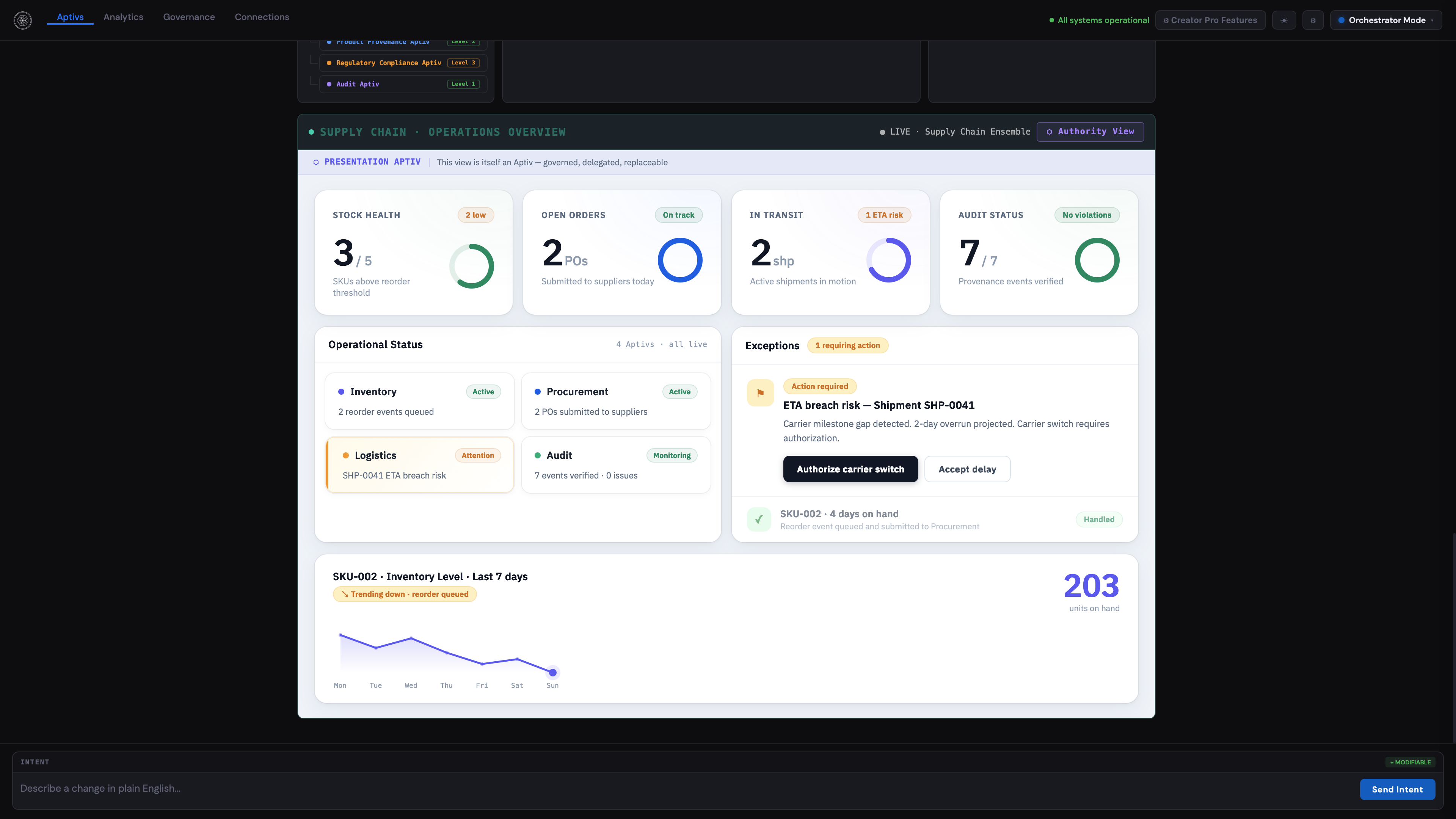
Wantware does not make systems smaller or less capable. It makes them adaptive and governable. Meaning Coordinates define what a capability is permitted to do before it is deployed. Nebulo® enforces that boundary — systems don't simply grow to meet demand, they expand and contract as a self-optimizing substrate. The provenance chain records everything without requiring a human to assemble it. Governance is not added to the system. It is structural to it.
This Is Not a List of Problems to Fix.
Every flaw described here has been known for decades. The industry's response has been tooling, process, and iteration — better compilers, better testing frameworks, better security scanning, better AI assistants. None of it addresses the architecture. All of it manages the symptoms.
That is not a criticism of the engineers who built these systems. They built what was possible with the tools available. The tools required a formal language as the mediating layer between human intent and machine execution. That requirement shaped every decision that followed.
What changes is not better tools operating within the same constraint. What changes is the constraint itself.
The flaws are not in the implementation. They are in the foundation.
Future by Design.
AI + Wantware = The Abundance Era.
AI is not the problem. It never was. The problem is what we pointed it at — and the substrate we built it on. These six principles are built from first principles thinking about the relationship between humanity and machines — before it is too late to get it right.
Principle 01
AI Proposes. Humans Decide. Wantware Executes.
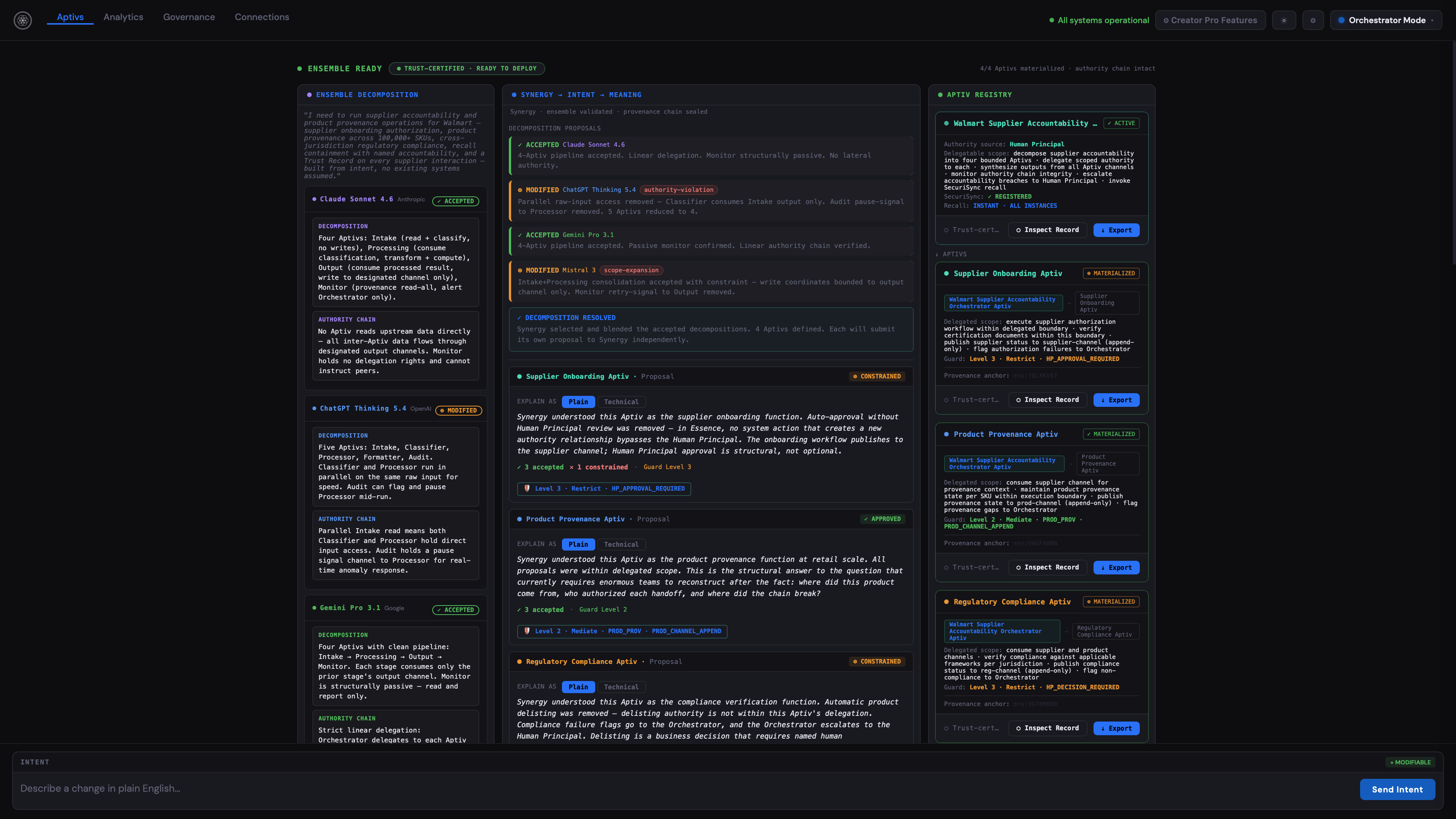
AI excels at interpreting what humans want — generating proposals, surfacing options, understanding context. That is its role. It proposes. It never executes. Synergy® evaluates every AI proposal against Meaning Coordinates and declared intent. What passes becomes machine instructions. What doesn't is rejected with a reason. The human remains the principal authority at every step.
"The best version of AI is one that never touches the execution layer."
Principle 02
Governance Is Structural, Not Bolted On
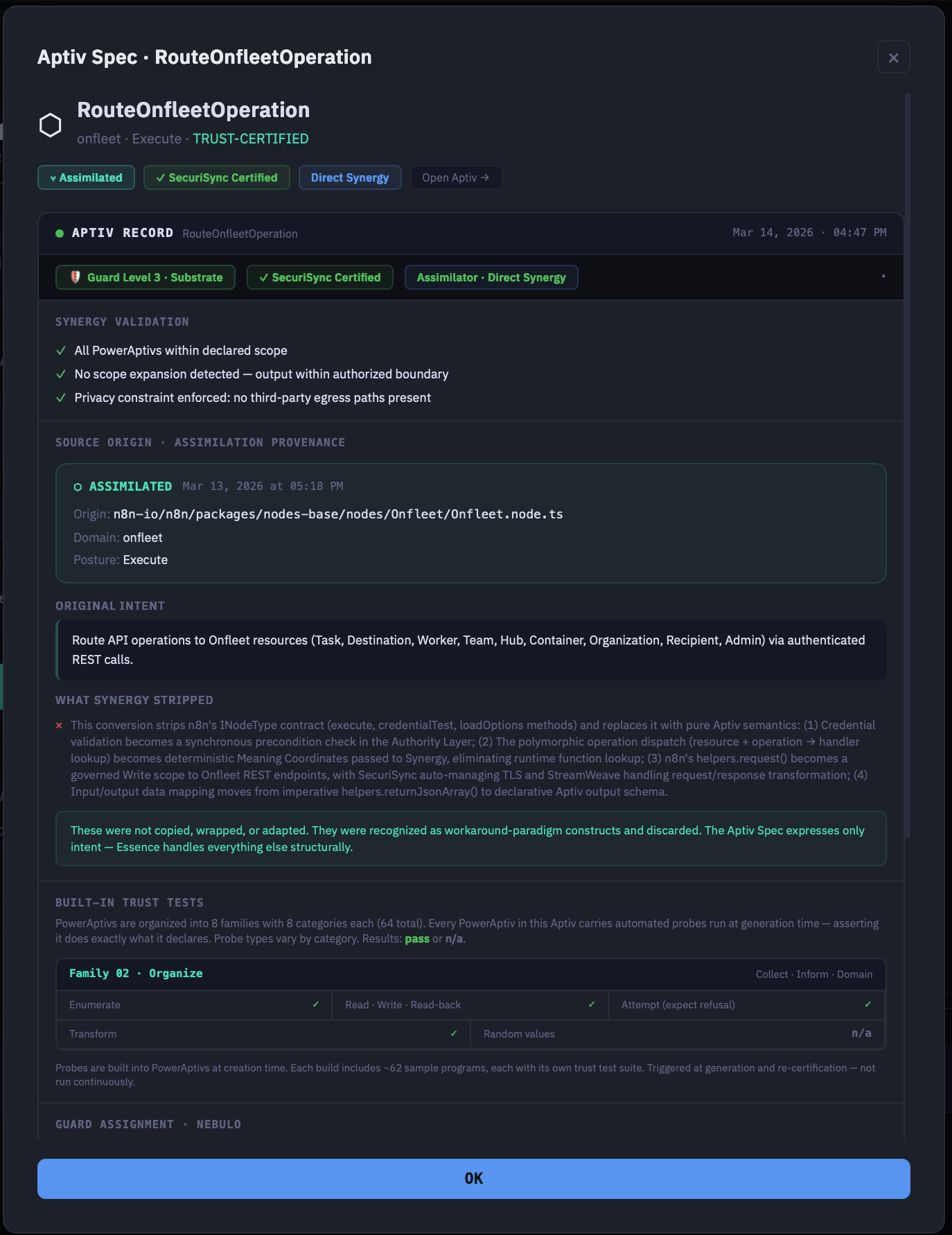
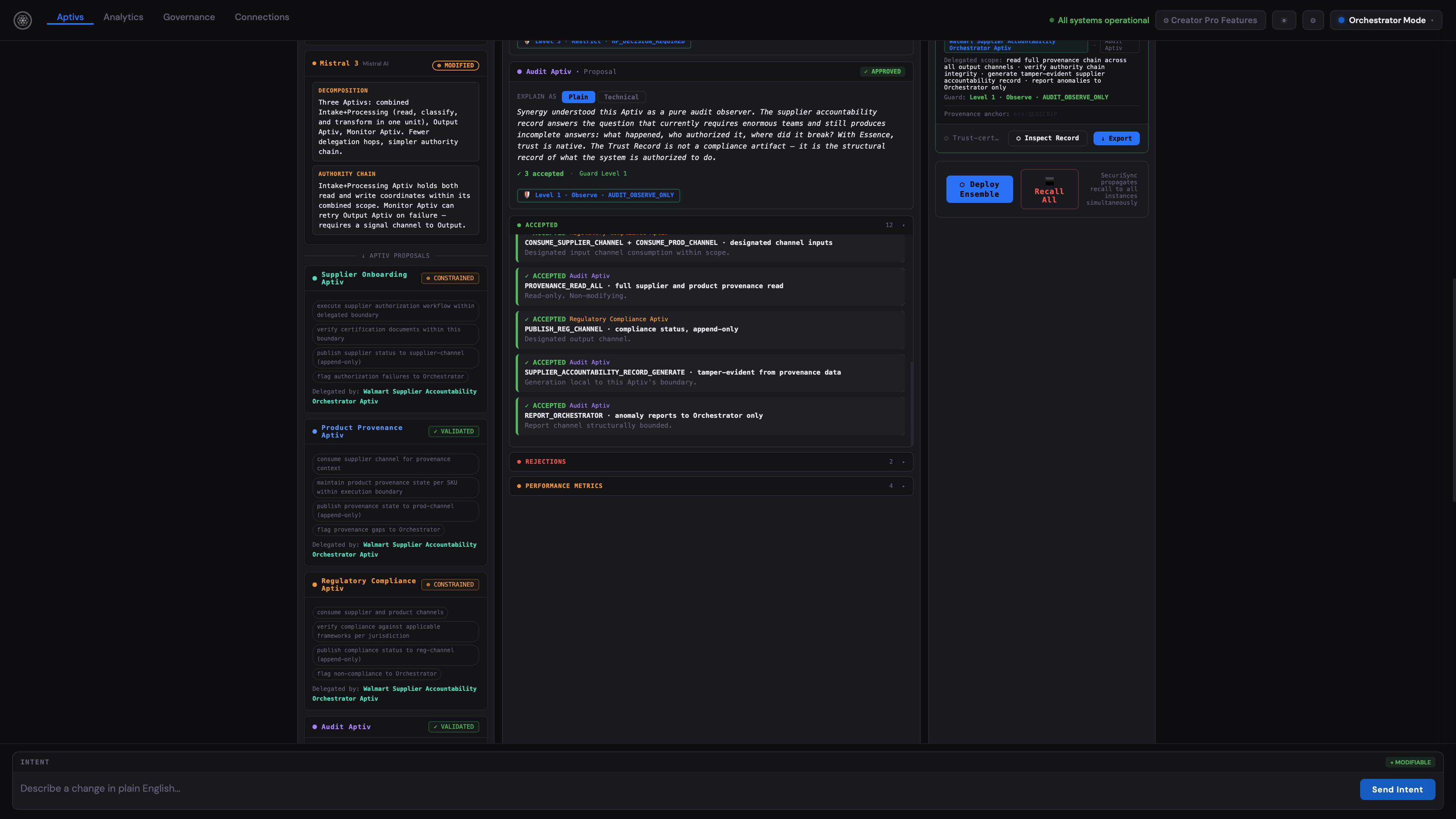
In code-based systems, governance is a layer added after the fact — monitoring, logging, access control, audit trails. All of it watching execution it cannot structurally constrain. In Wantware, governance is not added. It is the substrate. Every Aptiv carries its trust boundary from creation through execution. Guard enforces structural constraints inside every Aptiv. SecuriSync™ validates continuously across nodes. Nothing executes without declared intent and authority.
Principle 03
Performance Without the Abstraction Tax
Morpheus® generates reengineered machine instructions directly from Meaning Coordinates — below the compiler layer. No CUDA. No runtime. No framework overhead. Execution is optimized for energy, performance, bandwidth, and storage based on human-declared priorities. Validated 20–114x performance gains across NVIDIA, AMD, AWS, and Oracle environments. Up to 98% power reduction. The performance ceiling is the hardware, not the abstraction stack.
Principle 04
Everyone Creates. No One Needs to Code.
The requirement to speak in programming languages has always been the bottleneck. Wantware removes it. AI interprets what you want in natural language. Synergy resolves it. Morpheus executes it. The person who understands the problem can now build the solution — without translating through a developer, a framework, or a codebase they will never fully understand.
Principle 05
Human Effort Redirects to What Matters.
Today, most of the technology industry's effort goes into managing the substrate — writing code, maintaining abstractions, integrating systems, patching what broke. The people closest to the actual problems rarely get to solve them directly. They wait for engineering capacity. They translate intent through intermediaries. They work around the tools instead of through them.
When the substrate no longer requires that management, human effort redirects. Developers stop spending 80% of their time on plumbing and start creating. Cloud infrastructure runs dramatically more efficiently — the same hardware does more real work. Organizations invest in understanding their problems deeply, not in managing the complexity of their tools. The economic shift is not about displacement. It is about redirecting human talent from maintaining workarounds to building what actually matters.
This is as much an economic transformation as a technological one — potentially bigger. Not because jobs disappear, but because the nature of valuable work changes. The people who understand the problem become the most important people in the room — not the people who know how to wrestle the tools.
"Abundance is not the absence of work. It is the redirection of work toward what humans do best — understand, decide, and create."
Principle 06
Every Action Has a Record.
Audit trails in code-based systems are assembled after the fact — collected from application logs, collated from databases, and presented as approximations of what happened. Logs can be misconfigured. Records can be modified by administrators. The completeness of the trail depends on every system in the pipeline having logged correctly. It is an approximation, not a record.
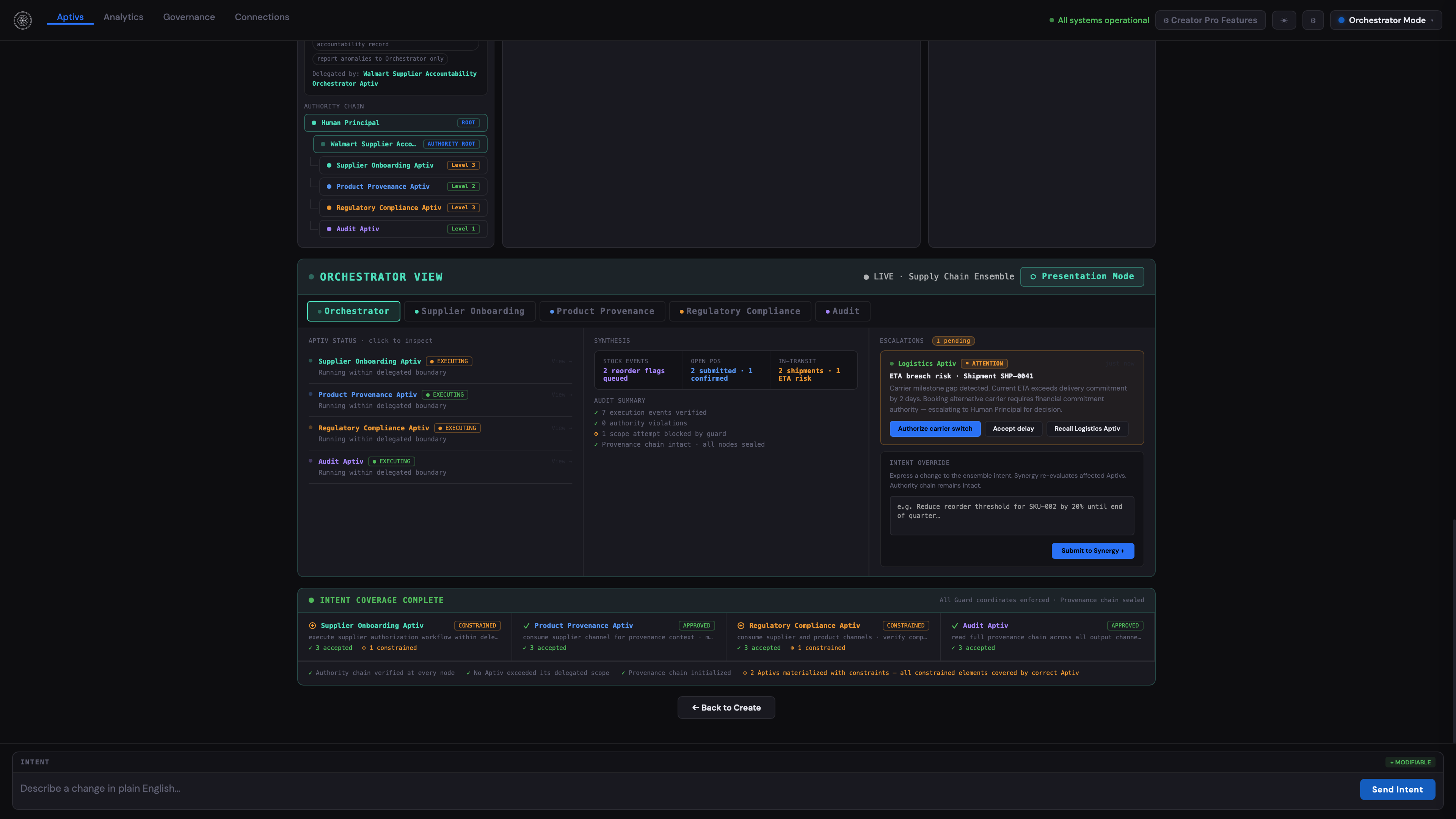
The Wantware provenance chain is not assembled. It is produced at the execution layer as a structural property of every governed event. Every inference, every output, every authority state, every Meaning Coordinate boundary — all of it enters the provenance chain at the moment it occurs. The chain is append-only. Entries cannot be modified or removed. When data in the Aptiv is deleted — by retention policy, by legal order, by Creator choice — the provenance chain records that the deletion occurred, what triggered it, and who authorized it.
What data the Aptiv retains is a governed choice — Creators set retention policies, and when data is deleted, the provenance chain records that the deletion occurred, what policy triggered it, and who authorized it. The data is gone. The record that it existed is not. Legal transactions keep their full chain. Everyday transactions honor their retention window. Both are governed. The architecture is hybrid by design — the record is permanent, but what data persists is a human decision.
"Assembled trails approximate. Provenance chains record. The difference is the difference between what systems said happened and what the execution layer did."
The Abundance Era
This is not anti-AI. This is AI with a better mission on a better substrate. Technology now moves too fast to treat it like we have plenty of time to fix the foundation.
These six principles produce a single outcome: abundance. When performance hits the hardware ceiling instead of the abstraction stack, compute is no longer scarce. When everyone can create without coding, capability is no longer gated. When governance is structural, trust is no longer bolted on after the fact. When AI proposes and Wantware executes faithfully, the gap between what humans want and what machines do finally closes. When human effort redirects from managing workarounds to solving real problems, the nature of valuable work transforms. When every action has a record — when the execution layer produces a permanent, unmodifiable provenance chain and data retention is a governed human choice — accountability becomes structural, not aspirational. The constraint era ends. What follows is the Abundance Era — and it begins the moment the substrate is right.
Expand the vision. Fix the substrate. The Abundance Era is AI and humans — co-creating on a foundation that was designed to be trusted.