Software vs Wantware Layers
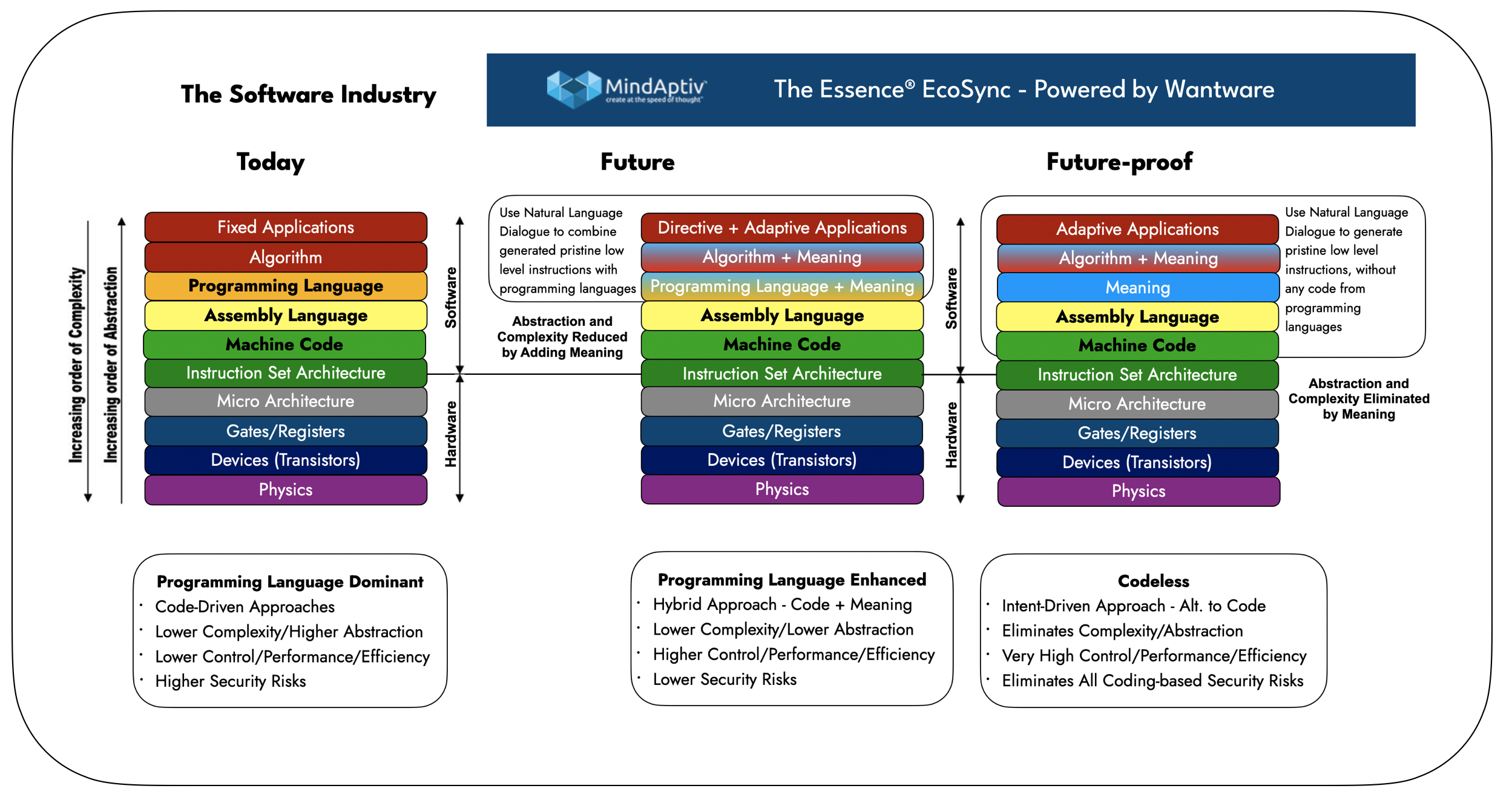
A stack-level comparison of how conventional software and Wantware relate to the underlying execution layers. This shows where complexity accumulates in today's software model, and how adding meaning changes the tradeoffs between abstraction and control.
This page describes the design. Today, only the GPU optimization build at adaptwithchameleon.com runs. File-based output is re-established during the first 30 days of funded milestone work, and the OS-hosted runtime, illumin8 and the other Aptivs return when the milestones are complete. Wantware is not about writing or generating code as applications.
Left: today's code-driven stack. Middle: a hybrid path (code augmented with meaning). Right: future-proof Wantware, with meaning as the source of truth.
What the comparison says
Today · Programming-Language Dominant
Abstraction reduces effort, but usually lowers direct control over performance and efficiency, and increases attack surface and stack fragility. Every layer adds translation, dependencies, and places where intent can be lost between the developer's head and the machine.
Hybrid · Programming-Language Enhanced
Meaning augments code to reduce complexity and improve control without breaking standard workflows. Existing codebases keep working; meaning layers get added where they reduce friction, improve governance, or enable optimization that code alone cannot express.
Wantware · Future-Proof / Codeless
Meaning collapses unnecessary abstraction layers and enables adaptive execution, while retaining a clean path to export artifacts when required. The system reasons about what work needs to happen at the level of intent rather than through brittle chains of compiler, framework, and runtime handoffs.
Why this matters for SDLC and governance
Build Compatibility
You can still produce scan-ready outputs when required. Moving toward meaning-driven execution does not force teams to abandon their build tools, compliance pipelines, or artifact repositories.
Runtime Leverage
Where allowed, governed runtime mode enables continuous optimization with clearer controls. Performance work that conventionally happens once (at build time) can be applied continuously with policy-bounded adaptation.
Auditability
Intent plus lineage provides better why this changed answers than code diffs alone. Governance audits benefit from being able to reason about what a change was meant to accomplish, not just what lines were altered.
The diagram
A visual side-by-side comparison of software and Wantware layers (Today to Hybrid to Future-proof).
The transition from code-dominant stacks to meaning-driven execution does not require disruption. Teams can maintain scan-ready build outputs and compliance pipelines today while incrementally enabling governed runtime behaviors that improve performance, traceability, and operational control.