Qcode & Morpheus
Qcode is the ephemeral machine code Essence generates at runtime from Meaning Coordinates. Morpheus is the Aptiv that generates it. Neither is a build artifact; both exist only during execution and are discarded once a task completes.
The execution flow
The path from intent to hardware follows a single chain:
Meaning Coordinates → Morpheus → Qcode → Hardware
No intermediate compiler, no pre-written code, no static binary. Morpheus reads the Meaning Coordinates, carried inside Aptivs, that describe what needs to happen and hold the job details needed for processing, assesses the execution environment in real time, and generates Qcode, machine instructions precisely tailored to the available hardware at that moment. Once execution completes, the instructions are discarded.
What Qcode is and is not
Qcode is not a programming language, an intermediate representation, or a compiled output. It is a runtime execution model: live, adaptive, and directly responsive to evolving conditions, workloads, and hardware availability.
SPIR-V is the format Chameleon generates today to reach GPUs. Exporting SPIR-V as a file is not available yet, and direct PTX and GCN emission are on the roadmap. Qcode is exclusively generated by Morpheus and cannot be produced by any other path.
Chameleon generates SPIR-V at runtime. File export of SPIR-V for external pipelines is not available yet. Qcode itself is a runtime phenomenon: it is generated, executed, and deleted within a single session.
How Morpheus tunes execution
Traditional compilers operate at levels 5–8 of a software stack: procedures, algorithms, instructions, and operators. Morpheus operates across all eight levels, from architecture-level strategies down to individual instruction scheduling, enabling tuning that no static compiler can perform.
| Level | What it covers | Traditional compiler reach |
|---|---|---|
| 1 · Architecture | System-wide strategy, hardware topology, cross-device orchestration | No |
| 2 · Engine | Stateful systems, model selection, multi-engine coordination | No |
| 3 · Service | Composable behavior flows, service orchestration | No |
| 4 · Algorithm | Logic structures, data transformations, optimization selection | No |
| 5 · Procedure | Defined logic paths, control flow | Yes |
| 6 · Operator | Primitive operations: arithmetic, conditionals, memory access | Yes |
| 7 · Instruction | Hardware instruction selection and scheduling | Yes |
| 8 · Register | Register allocation, pipeline interleaving, core assignment | Yes |
Morpheus evaluates memory latency, read/write access patterns, GPU sampler fetches, instruction cycles, cache utilization, vector capabilities, core synchronization, hyperthreading, and clock speed to determine how to allocate, interleave, and pipeline workloads. This transforms traditional instruction scheduling into real-time, adaptive orchestration.
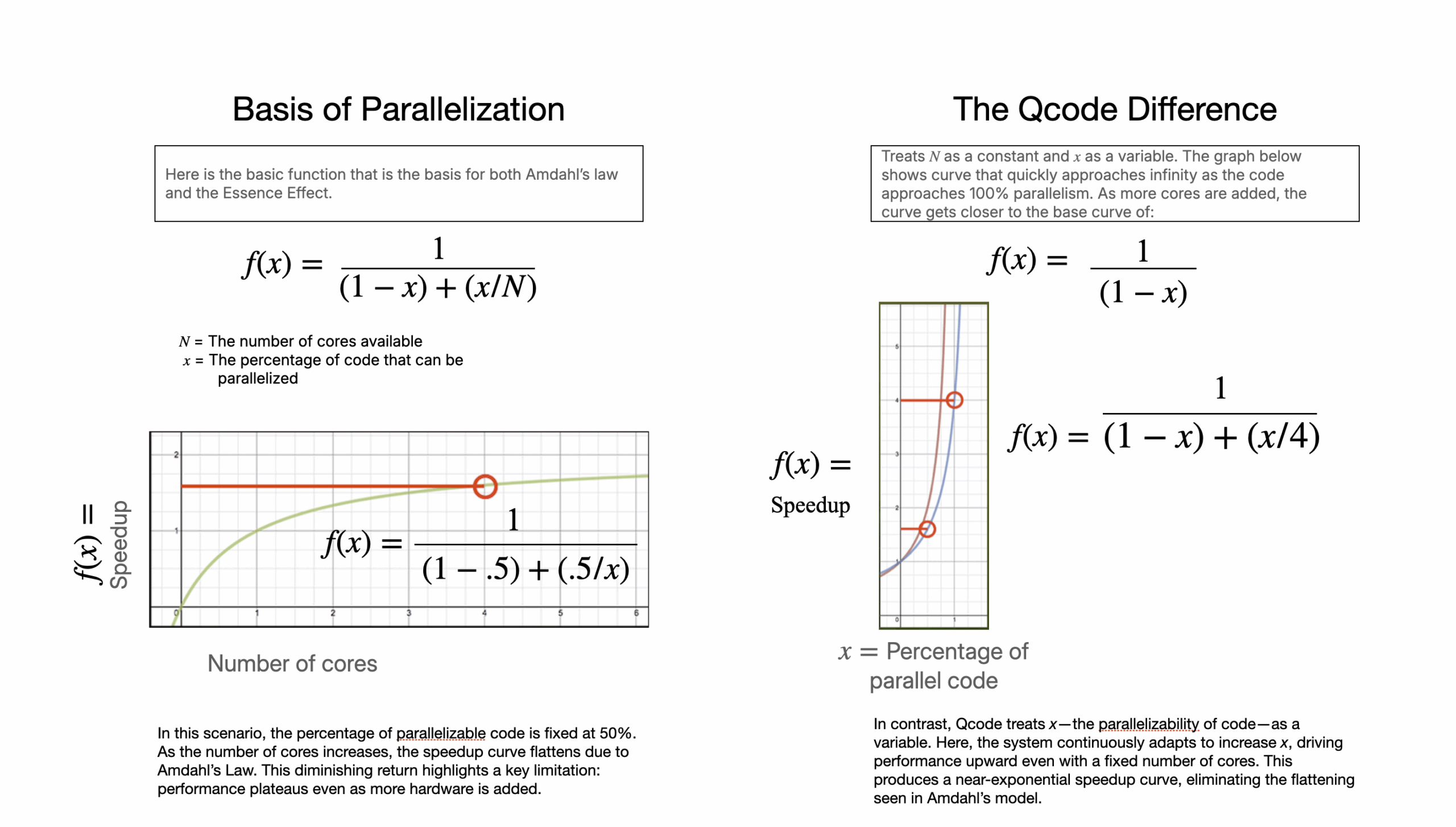
Dynamic parallelism: beyond Amdahl's Law
Amdahl's Law treats the parallelizable fraction of a workload as fixed, which produces a ceiling on performance gains as more cores are added. Qcode treats that fraction as a dynamic variable, one that can be improved continuously as execution progresses.
Instead of accepting diminishing returns, Morpheus actively identifies serial dependencies, routes around them, and restructures work across available cores in real time. The result is that performance scales with additional hardware without hitting the plateau Amdahl's model predicts for static code.
Demonstrated result
In testing on an unmodified 2011 Mac Pro, rendering multiple high-polygon 3D models was reduced from 32 minutes (serialized execution) to 18.8 seconds (Qcode parallelism), a 103× speedup on hardware that was not modified or upgraded. The gain came entirely from eliminating static execution constraints, not from adding compute resources.
The 103× figure is a specific result for a high-polygon rendering workload on a 2011 Mac Pro. Real-world gains vary by workload type, dependency structure, and hardware. The underlying mechanism (dynamically increasing the parallelizable fraction rather than accepting it as fixed) applies broadly, but results should be validated against the target workload.
The lockless execution model
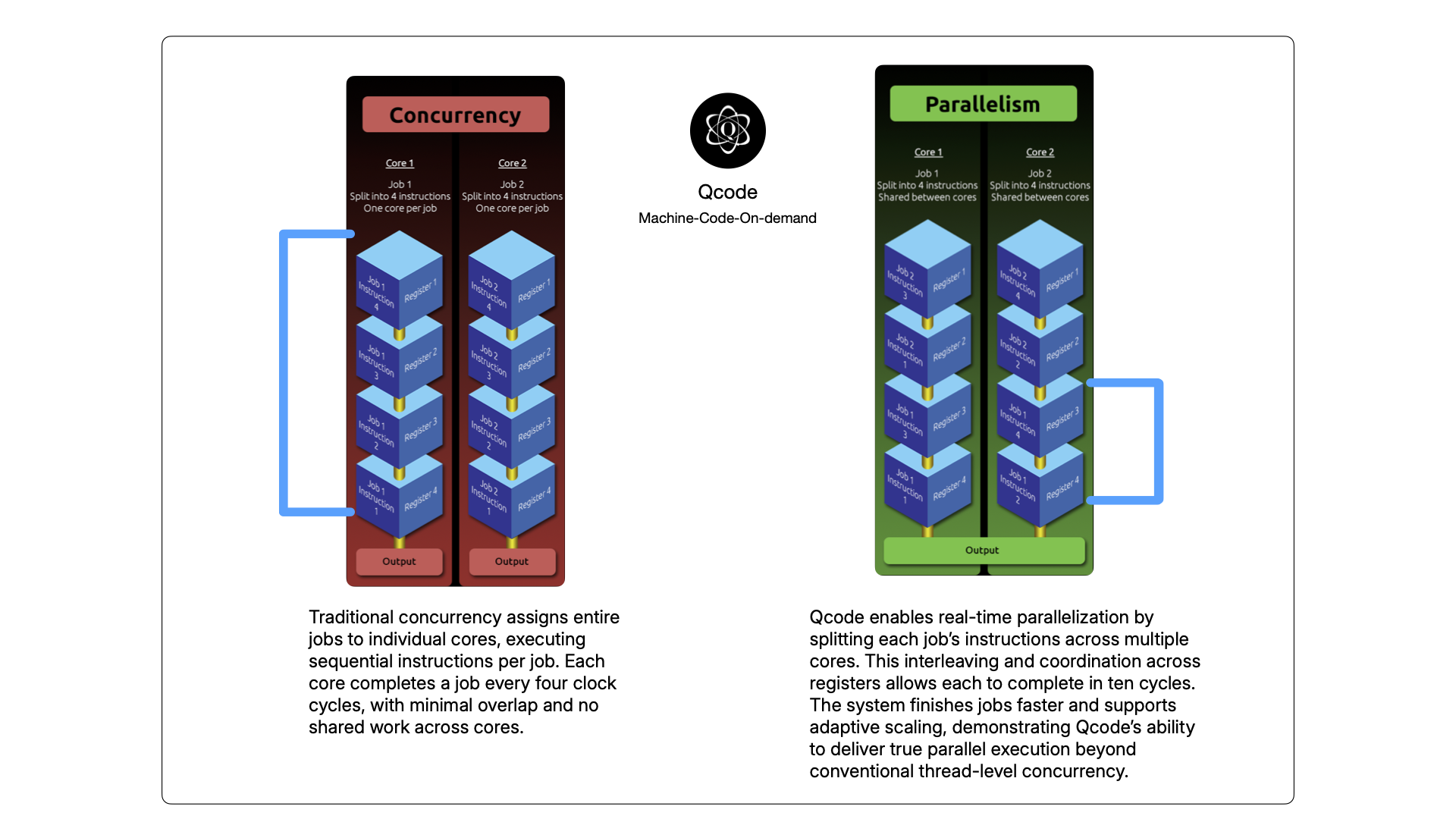
Conventional concurrency relies on semaphores, mutexes, and thread locks to coordinate access to shared resources. These primitives introduce contention, cache misses, and serialization bottlenecks that reduce throughput even on multi-core hardware.
Qcode operates in a lockless environment. Rather than coordinating threads around shared state, Morpheus decomposes workloads into atomic units, tracks their dependencies explicitly via Meaning Coordinates, and distributes them across cores without requiring synchronization primitives. Memory is managed dynamically to eliminate fragmentation, and jobs are scheduled to avoid cache stalls before they occur rather than recovering from them after.
Qcode vs. traditional code
| Property | Traditional code | Qcode |
|---|---|---|
| Compilation | Static; compiled ahead of time for a fixed target | Generated at runtime for the actual executing environment |
| Parallelism | Fixed fraction; subject to Amdahl's ceiling | Dynamic fraction; continuously improved during execution |
| Concurrency model | Thread locks, mutexes, semaphores | Lockless; dependency-tracked scheduling |
| Memory management | Static allocation; fragmentation accumulates | Dynamic reuse; fragmentation eliminated where permitted |
| Performance tuning | Manual; requires recompilation per target | Continuous; Morpheus adapts to live hardware state |
| Platform portability | Platform-specific binaries required | Cross-platform via [.wv] streams; no recompilation |
| Persistence | Binary remains on disk; accumulates debt | Ephemeral; generated, executed, and discarded |
Morpheus generates Qcode at runtime from Meaning Coordinates, no compilation step, no static binary, no platform-specific tuning required. Chameleon generates SPIR-V at runtime today; exporting it for existing pipelines is not available yet. Full runtime Qcode generation is the deeper capability that activates as the platform matures toward the Synergy milestone.